
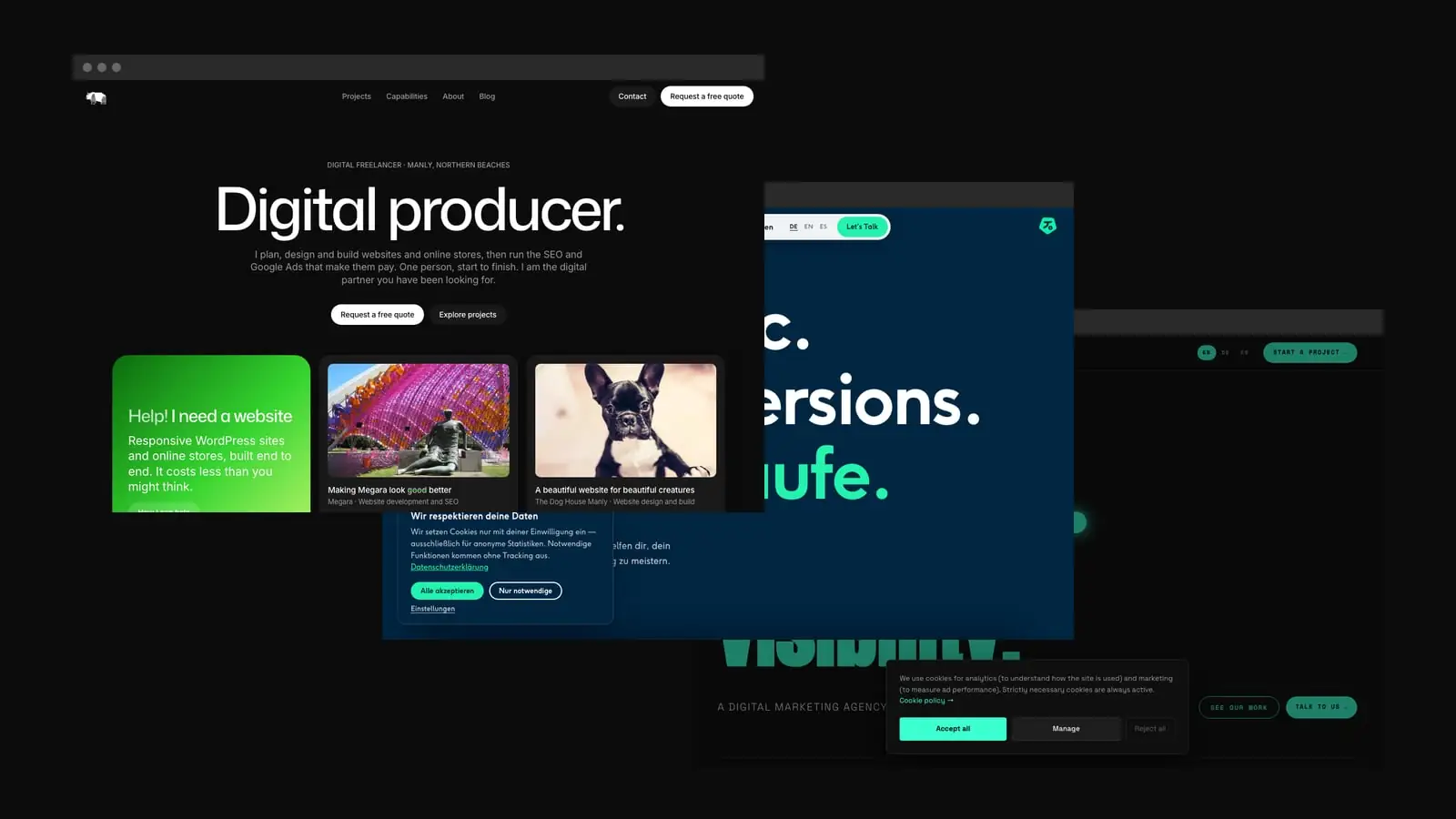
Yes, really free. I plan, design and build your website as plain HTML at no charge, and you own it outright. The condition is that I run your advertising, Google Ads and Meta ads, on a minimum-term retainer agreed up front. The site takes me days rather than weeks the way I build now; the advertising is where I make my living, and a fast, honest website is what makes advertising pay. This site, tikitaka.digital and pmax.online are built the same way.
Every “free website” offer has a catch, so here is mine before anything else: I build the site for nothing because I want to run your advertising. If that is not something you need, stop reading and go and enjoy the beach. If it is, the rest of this page explains exactly what you get, what you commit to, and why the maths works for both of us.
The deal, in plain terms
- You get a website planned, designed, written with you and built by me: the pages a small business actually needs, working on every screen, with SEO foundations, structured data, analytics behind a consent banner, and a contact form that reaches you. Hosted on an account in your name, on a domain in your name.
- I charge nothing for it. Not a deposit, not a “design fee”, not a surprise at the end.
- You commit to a minimum-term advertising retainer: a monthly management fee to me, and an ad budget you pay to Google and Meta directly. Both numbers are agreed in writing before I open a text editor.
- You own everything from day one: the site, the domain, the hosting, the Google Ads and Meta accounts, and the data in them. I work in your accounts, not the other way round. I have written about why that matters.
- When the term ends, you can keep advertising with me or stop, and the website stays yours either way. What happens if you leave early is written into the same agreement, and it is fair.
Why I can afford to give the website away
Two reasons. The first is how I build now. Since 2026 every site I make is plain HTML generated from content files: no content management system, no database, no plugins, no licences. That removes most of the hours a website used to cost, and all of the hours it used to cost after launch. A brochure site takes me days.
The second is that I have spent fifteen years watching advertising budgets bounce off slow, broken, template websites. A campaign is only as good as the page it lands on. If I am going to be judged on your cost per enquiry, I would rather build the page myself than argue with a theme.
What “HTML website” means in 2026, and why it is not a step backwards
A quick history. The web started as HTML files. Then content management systems such as WordPress arrived so that non-developers could edit pages, and for fifteen years almost every small-business site was built on one, mine included. The trade-off was never advertised: a database that can fail, a plugin stack that needs updating every week, a login page that gets attacked every day, and pages assembled on the fly, which is slower than pages that already exist.
The WordPress version of this very site made the point for me. In March 2026 its database quietly died. The only reason visitors saw anything for the next six months was a caching plugin serving copies it had made on 5 March. Nobody noticed, because nobody was updating it. That is the failure mode of most small-business WordPress sites. Not hacked. Just quietly dead behind a cache.
The way I build now, the pages already exist as files. A server hands them over and does nothing else. That gives you:
- Speed. The homepage of this site loads in eleven requests and under half a megabyte on a phone, with eight kilobytes of HTML and no JavaScript framework. Speed is a ranking signal Google documents under page experience, and it is the difference between a paid click that converts and one that bounces.
- Security. There is no login page, no database and no plugin to exploit. Nothing to patch on a Sunday night.
- Nothing to maintain. No update emails. No “your site is running an outdated version”. The hosting bill is the cheapest tier anyone sells.
- Readable by machines. Clean HTML, structured data on every page, an llms.txt for language models, and no wall of scripts between a crawler and your content. That matters more every month.
- Changes through me, usually the same day. You email the change, I make it, it is live. For the handful of edits most businesses make in a year, that is faster than logging in.
And the honest limits: if you will genuinely publish something every day, or run a store with hundreds of products, a content system or a store platform is the right tool and I will say so at the first meeting rather than the last.
Three sites built this way
- digitalfreelancer.net.au, the site you are reading. Twenty-five pages generated by one small script; the only code that runs on the server is a single file for the contact form.
- tikitaka.digital, my Hamburg agency, generated to static files and hosted the same way.
- pmax.online, my Mallorca agency, in English, German and Spanish, also generated to static files. Three languages, no CMS.
Who it suits, and who it does not
It suits a local service business with a clear offer and customers who search before they buy: trades, health and allied health, hospitality, professional services, tourism operators. Businesses whose advertising, done properly, pays for itself many times over. If that is you, a website that costs nothing and a campaign run by someone whose income depends on it working is a reasonable deal.
It does not suit a business that does not want to advertise, a marketplace, a large catalogue, or a publisher. It is also not for anyone who wants a website and no relationship. I am one person, and this only works if we both intend to be around for a while.
What the first month looks like
- Week one. A conversation about the business, the customers and the numbers. Site structure and the copy, drafted with you, in your words.
- Week two. Build, review on your phone, fixes, launch. Tracking and the consent banner go in before the first ad runs.
- Week three onwards. Campaigns live. A report each month that leads with enquiries and what each one cost, not with clicks.
If you want to know whether the deal makes sense for your business, tell me what you do and roughly what you could spend on advertising. I will tell you straight, and it costs nothing to ask.
Questions people ask
Is the website really free?
Yes. There is no charge for planning, design, copy help, build or launch. The condition is a minimum-term advertising retainer, with the monthly management fee and the ad budget agreed in writing before work starts.
What exactly am I committing to?
A minimum term of advertising management. You pay me a monthly fee to run Google Ads and Meta ads, and you pay the ad budget itself directly to Google and Meta. Both numbers are fixed up front.
Who owns the website and the ad accounts?
You do, from day one. Domain, hosting, code, content, Google Ads and Meta accounts, and all the data in them are in your name. I work inside your accounts through access you can revoke.
What if I stop advertising?
After the minimum term you can stop and keep the website. If you stop before the term ends, the agreement sets out what is owed for the site, and you still keep it.
Can I edit the site myself?
Most clients do not need to. You send me the change and it is usually live the same day. If you will genuinely edit every day, say so at the start and we plan for a content system instead.
Is a static HTML website bad for SEO?
No. It is the fastest, cleanest thing a crawler can read, which is why this site is built that way. Rankings come from content, structure and links, and a hand-built site gives you full control over all three.
Do you build online stores this way?
Not fully. A store needs a checkout, stock and customer accounts, so it goes on a store platform chosen for the size of the business. The marketing side of the offer works the same way.
Sources
- Understanding page experience in Google Search results, Google Search Central
- Web Vitals, web.dev
- Core Web Vitals report, Search Console Help
- Creating helpful, reliable, people-first content, Google Search Central
- Updating WordPress, WordPress.org
- The /llms.txt file, llmstxt.org