
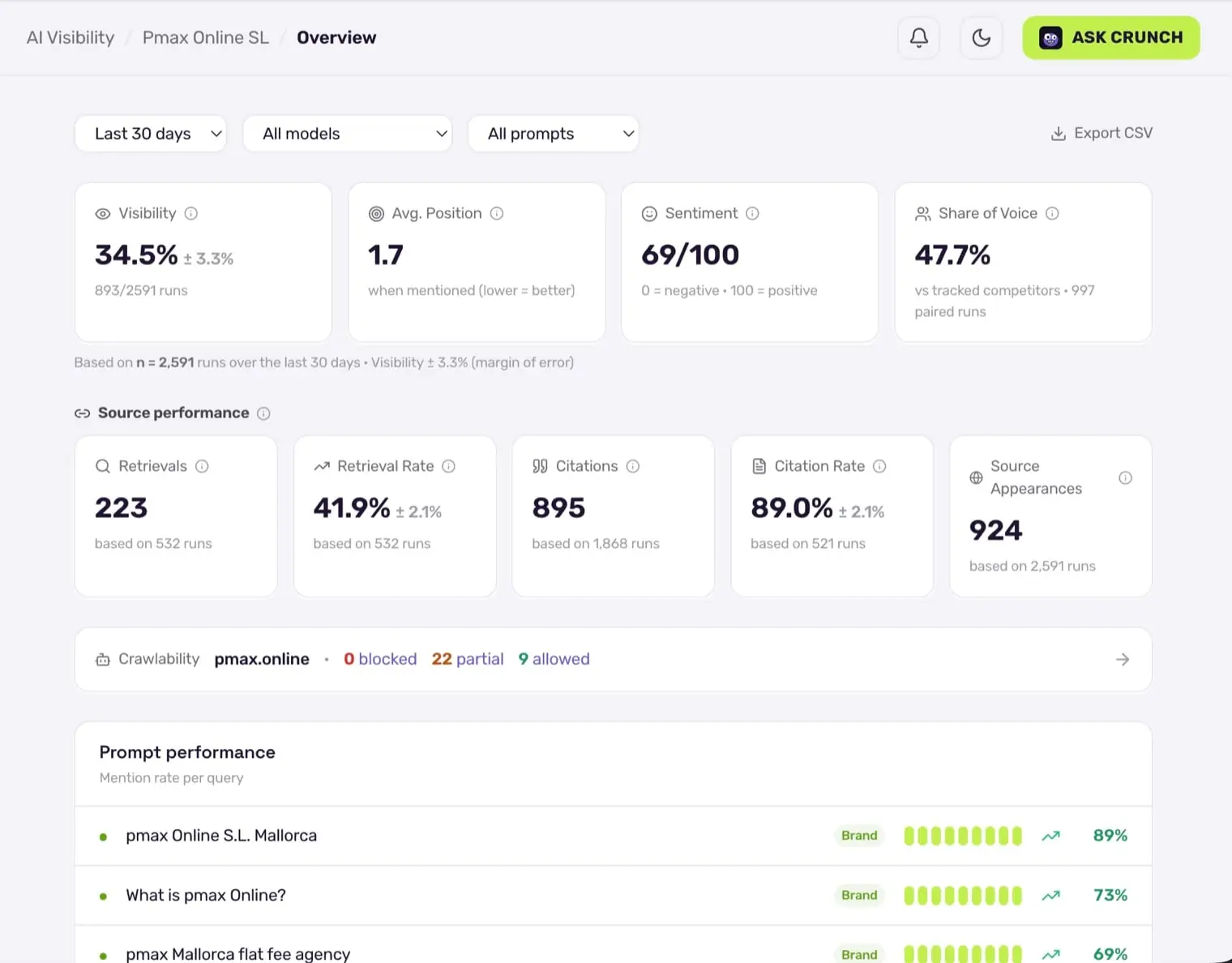
Ask the assistants the questions your customers ask, several times each, on several engines, and write down who gets named, in what position, and which websites the answer cites. Ten prompts by hand tells you where you stand. A tracking tool does the same across hundreds of runs and states the margin of error. Then fix the sources: the pages the engines actually read.
Try it now. Open ChatGPT or Google’s AI Mode and ask for the best whatever-you-do in your suburb. If you are not in the answer, a competitor is, and the customer never saw a list of ten blue links to scroll past you on. I run this check for my own three businesses every month, and I built the tool that does it at scale, so here is the honest version: how to do it yourself, when a tool earns its money, and what actually moves the needle.
Why this is not a fad
Google now answers a large share of searches itself, with AI Overviews at the top of the results and AI Mode as a full conversational search. Its own documentation says these features are built on the same crawling and ranking foundations as classic search, which is good news: the work is familiar. ChatGPT, Perplexity, Gemini and Copilot do the same thing without the blue links underneath. Someone asks for a physio in Dee Why who does weekend appointments and gets three names, not ten links. For a local service business, the shortlist is the whole game. Search Console has started reporting on how your pages perform inside Google’s AI features, which tells you Google thinks this matters too.
What “AI visibility” actually means
It is four things. How often you are mentioned when someone asks a question you should be the answer to. Where in the list you appear. How you are described, which is the part that decides whether the mention helps. And which sources the engine leaned on to build the answer, because those sources are your to-do list.
One catch before you start: the same prompt gives a different answer every time you ask it. Engines sample, sources rotate, and the wording of the question shifts the shortlist. One check is an anecdote. Five checks are a hint. Fifty checks with the sample size written next to the percentage are a measurement. Keep that in mind when anyone, including me, shows you a number.
The Saturday-morning method, which costs nothing
- Write ten prompts your customers would actually type. Not keywords, questions. “Best surf school in Manly for a nervous beginner.” “Who builds Shopify stores on the Northern Beaches?” “Is [your business] any good?” Mix questions that do not name you with a couple that do.
- Ask each one on four engines. ChatGPT, Gemini, Perplexity and Google’s AI Mode cover most of it. Use a temporary chat or a logged-out window so your own history does not flatter you, and note the location you are asking from.
- Ask each prompt twice. See the catch above.
- Record five things per answer. Mentioned or not. Position in the list. One line on how you were described. Who else was named. And the sources the answer cites, which you should click.
- Ask a follow-up. “Which of those does weekend appointments?” Getting named is round one. Surviving the second question is where the enquiry happens.
- Put it in a spreadsheet and repeat monthly. The trend matters more than the first number.
Ten prompts, four engines, two runs each is eighty answers and a couple of hours. Do it once and you will learn more about your market than most agencies will tell you. Do it monthly, with competitors, across ten engines, and it stops being a couple of hours. That is the point at which a tool pays for itself, and not before.
What the sources tell you, and what to fix
When you click the citations you will notice the answers are assembled from a handful of pages: a directory or two, a review site, a Reddit thread, a local blog, and your own website if it says plainly what you do, where, and for whom. That list is the fix list.
- Be on the pages that get cited. If every answer leans on one directory and two review sites, you need a complete, current listing on each, with reviews that describe the work rather than the weather.
- Make your site answer the question in plain sentences. Who you are, what you do, where, for whom, roughly what it costs, and the answers to the questions people ask before they call. Google’s guidance for doing well in its AI features is the same advice it has given for search for years: helpful content written for people, on pages a crawler can read. I wrote up the three factors that decide most rankings a while ago and none of them has changed.
- Add structured data. LocalBusiness, Service and FAQ markup tell machines the facts without making them guess. This site carries all three on every page.
- Do not block the crawlers you want. OpenAI documents which of its bots fetch pages for answers and which collect training data. Google’s AI features use its normal crawlers. Check your robots.txt against the documentation before you assume you are visible.
- Publish an llms.txt if it costs you nothing. It is a plain-text summary of your site for language models, an emerging convention rather than a standard, and the engines have not committed to reading it. This site has one because it took ten minutes. Do not pay anyone for it.
My own numbers, so you can see what “normal” looks like
For my Mallorca agency, tracked over the last ninety days across ten engines: the prompt “best Google Ads agency in Mallorca” named pmax in 44 of 246 runs, about 18 per cent. “Digital marketing agency Mallorca flat fee” named it in 111 of 243, about 46 per cent, because flat fees are the one thing every page on that site says plainly. “Marketing agency Mallorca reviews” named it in 8 of 240: we have not earned the review sites yet, and the engines know it. Even the brand question “Is pmax a good marketing agency?” produced an answer that named us in 105 of 249 runs, which means four times in ten the engines could not find enough about us to say.
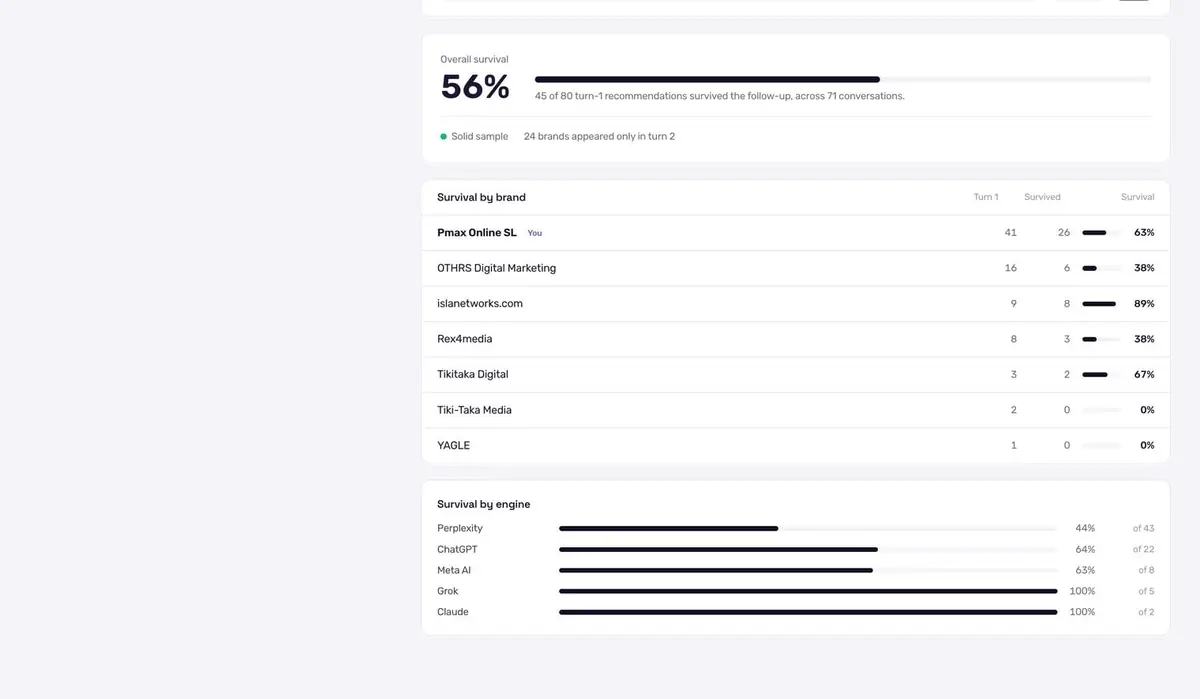
That is the pattern everywhere I look. Engines recommend you for the things your sources say plainly and repeatedly, and go quiet on everything else. The follow-up question is harsher still. In one recent batch of 71 conversations, just over half of the brands recommended in the first answer were still there after the customer narrowed the question.
When a tool earns its money
More than ten prompts, more than four engines, a monthly cadence, competitors in the same table, or a client who wants it in a report. Then, and only then. Whatever you use, demand five things from it:
- A sample size and a margin of error next to every percentage. A number without them is a guess with a decimal point.
- Several engines, because Gemini and ChatGPT disagree more often than you would think.
- The sources behind each answer, per answer, so you can act on them.
- A follow-up test, not just first mentions.
- No invented “AI search volume” figures. Nobody has that data. A tool that sells it is guessing.
Disclosure, and then the pitch: I built the AI visibility tracking tool CrunchJunkie because I wanted those five things for my own businesses and could not buy them. It runs your prompts against ten engines on a schedule, states the sample size and margin on every number, shows the sources behind each answer, runs the follow-up test, and ties the whole thing to the sessions and revenue those assistants actually send. There is a free check that needs no signup, which is the Saturday-morning method with the tedium removed. Otterly and Peec AI are the alternatives I would look at if you want a second opinion. If any tool refuses to show you its sample size, walk away.
The checklist
- Ten real customer questions, four engines, two runs each, one spreadsheet.
- Record mention, position, description, competitors and sources.
- Ask the follow-up.
- Fix the cited sources first: directories, reviews, then your own pages.
- Plain-sentence answers on your site, structured data, crawlers allowed.
- Repeat monthly. Move to a tool when the spreadsheet becomes a job.
If you would rather I ran the check and read the results with you, that is a normal part of the SEO work I do for businesses on the Northern Beaches. The first conversation costs nothing.
Questions people ask
What is AI visibility?
How often, and how well, AI assistants such as ChatGPT, Gemini, Perplexity and Google’s AI Overviews mention your business when someone asks a question you should be the answer to. It covers whether you are named, where in the list, how you are described, and which sources the answer relied on.
How do I track AI visibility for free?
Write ten questions your customers would ask, run each on four engines in a logged-out or temporary chat, ask each twice, and record whether you were mentioned, your position, how you were described and which sources were cited. Repeat monthly in a spreadsheet.
What is an AI visibility score?
Usually the share of prompt runs in which your brand was mentioned, expressed as a percentage. It is only meaningful with the number of runs and a margin of error next to it, because the same prompt returns different answers each time.
Why does the same question give different answers?
Engines sample from many possible answers, the sources they retrieve rotate, and small changes in wording or location change the shortlist. That is why one check is an anecdote and a measurement needs many runs.
Do I need GEO or AEO instead of SEO?
No. Generative engine optimisation and answer engine optimisation are new names for familiar work: plain answers on crawlable pages, structured data, presence on the sources engines cite, and reviews. The acronyms are marketing. The fundamentals are the same.
Does llms.txt improve AI visibility?
Not measurably yet. It is an emerging convention rather than a standard the engines have committed to. It costs nothing to publish, so publish one, but do not pay anyone for it or expect it to move the numbers on its own.
Sources
- AI features and your website, Google Search Central
- Top ways to ensure your content performs well in Google’s AI experiences on Search, Google Search Central Blog
- AI Mode in Google Search: updates from Google I/O 2025, Google
- Performance report (Search results), Search Console Help
- Introduction to structured data markup, Google Search Central
- Overview of Google crawlers and fetchers, Google Search Central
- Overview of OpenAI crawlers, OpenAI
- The /llms.txt file, llmstxt.org
- CrunchJunkie: AI visibility tracking and marketing reporting, CrunchJunkie (my own product; the pmax figures above come from its 90-day prompt data)